



Product List

- News Center:
- Home>
- News Center>
- Company News>
- News Details
Recommended Series | Cathepsin B Specific Substrates: A Complete Solution from Colony Screening to Precise Quantification
2026/4/30 9:25:33 Browse volume(10)Z-Arg-Arg-4MβNA
From "visual observation" to "precise quantification": The dilemma of cathepsin B detection.
In cathepsin B-related research, laboratories often face this conflict:
• Strain screening stage: Quickly picking positive clones from hundreds of colonies requires cumbersome pretreatment and high costs if using instruments directly, limiting efficiency.
• Enzyme activity determination stage: Simple qualitative observation cannot be quantified, making it difficult to use for kinetic data analysis.
A single substrate cannot simultaneously meet the needs of "rapid screening" and "precise quantification."
Substrate series: matching detection methods to experimental goals:
The Z-Arg-Arg substrate series from GeneSeqTools Bioscience & Technology provides a complete solution. Based on the core dipeptide recognition sequence (Z-Arg-Arg), we have designed a series of substrates with different signal reporter groups, allowing users to precisely select the most suitable tool according to their experimental stage and analysis platform:
Intuitive color development: Naphthylamide substrates are visually interpretable, suitable for high-throughput initial screening;
Precise quantification: Colorimetric/fluorescent substrates can be read by instruments, meeting enzymology research needs;
Flexible application: Phased selection, one-stop coverage from rough screening to precise measurement;

From "colorless" to "signal release": The core logic of cathepsin B substrate detection:
1. Specific recognition: Cathepsin B selectively cleaves the Z-Arg-Arg dipeptide sequence in the substrate.
2. Hydrolytic cleavage: The cleavage site is located between the dipeptide and the signal reporter group.
3. Signal release: The cleaved signal group (pNA, AMC, 4MβNA or βNA) transitions from a substrate-bound state to a free state.
4. Signal output: The free group produces a characteristic color or fluorescence, with signal intensity proportional to enzyme activity.
Throughout the entire series, the only variable is the released signal reporter group. It is precisely this difference that affects the substrate's sensitivity, instrument compatibility, and ultimate use in different applications, ensuring that each product delivers optimal performance according to experimental needs.
1. Colorimetric Substrate: Visible Rapid Screening Tool (Coupling Color Development)
Representative product:
Z-Arg-Arg-4MβNA (CAS: 100900-19-4)

Chinese Name: Z-Arg-Arg 4-methoxy-β-naphthylamide acetate salt
English Name: Z-Arg-Arg 4-methoxy-β-naphthylamide acetate salt
Abbreviation: Z-Arg-Arg-4MβNA acetate salt
CAS Number: 100900-19-4
Molecular Formula: C37H53N9O11
Molecular Weight: 799.88
Specifications: 100 mg / 500 mg / 1 g (Custom packaging supported)
Form: Off-white crystalline powder
Product Number: G04030009
Stock: Quasi-stock
Color: Magenta
Applications:
• Engineering strain initial screening: Coupling color development after plate culture, rapid visual identification of high-expression clones.
• Positive validation: No instrumentation required, enzyme activity can be judged by naked eye.
• High-throughput screening: Suitable for scenarios requiring processing of a large number of samples simultaneously.
Advantages:
• No instrument needed: Color development reaction visible to the eye, reducing equipment dependence.
• Economical and efficient: Suitable for large-scale initial screening, low cost per test.
• High-throughput friendly: Allows direct observation of hundreds of colonies in a petri dish.
Other colorimetric products:
• Z-Arg-Arg-βNA Acetate (CAS: 2237216-27-0)
2. Colorimetric (Absorbance) Substrate: Standard Solution for Direct Quantification
Representative product:
Z-Arg-Arg-pNA ∙ 2HCl (CAS: 201807-90-1)
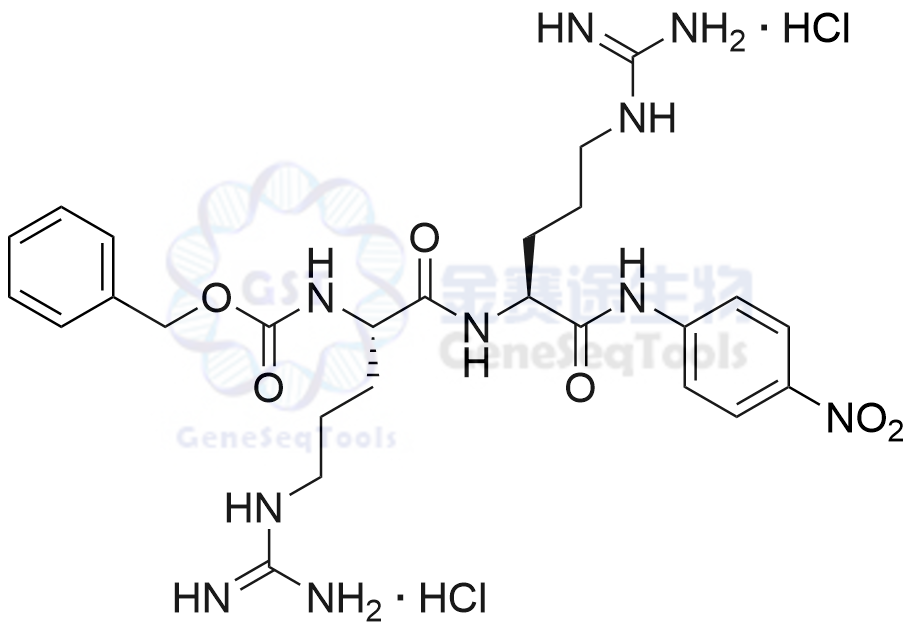
Chinese Name: Z-Arg-Arg p-nitroanilide dihydrochloride
English Name: Z-Arg-Arg p-nitroanilide dihydrochloride
Abbreviation: Z-Arg-Arg-pNA ∙ 2HCl
CAS Number: 201807-90-1
Molecular Formula: C26H38Cl2N10O6
Molecular Weight: 657.55
Specifications: 100 mg / 500 mg / 1 g (Custom packaging supported)
Form: Off-white crystalline powder
Product Number: G04030044
Stock: Quasi-stock
Color: Yellow
Applications:
• Enzyme activity determination: Precisely calculate enzyme activity units via absorbance values.
• Fermentation process optimization: Quantitatively compare enzyme yields under different conditions.
• Kinetic studies: Determine parameters such as Km and Vmax of enzymatic reactions.
Advantages:
• Precise quantification: Free pNA directly produces an absorption peak at 405 nm without secondary color development; absorbance is linearly related to enzyme activity.
• Good reproducibility: Suitable for standardized operations, strong comparability of inter-batch data.
3. Fluorescent Substrate: High Sensitivity Research-Grade Choice
Representative product:
Z-Arg-Arg-AMC (CAS: 136132-67-7)
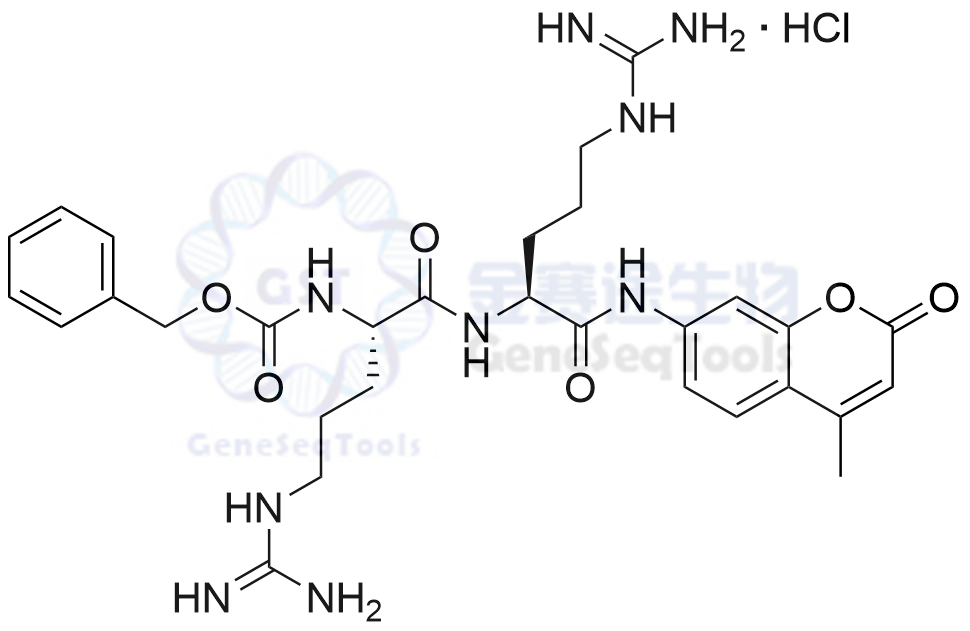
Chinese Name: Z-Arg-Arg 7-amino-4-methylcoumarin hydrochloride
English Name: Z-Arg-Arg 7-amino-4-methylcoumarin hydrochloride
Abbreviation: Z-Arg-Arg-AMC ∙ HCl
CAS Number: 136132-67-7
Molecular Formula: C30H40ClN9O6
Molecular Weight: 658.16
Specifications: 100 mg / 500 mg / 1 g (Custom packaging supported)
Form: Off-white crystalline powder
Product Number: G04030043
Stock: Quasi-stock
Fluorescence: Blue
Applications:
• Trace sample detection: Suitable for experiments with limited sample volume.
• Enzyme kinetics studies: Real-time monitoring of reaction progress to obtain accurate kinetic parameters.
• High-sensitivity quantification: Detects enzyme activity at the pmol level.
Advantages:
• Real-time monitoring: Allows continuous reading to obtain complete reaction kinetic curves.
• High-throughput compatibility: Compatible with 96/384-well plate automated detection platforms.
• Low background interference: High signal specificity, low false positive rate.
• High-throughput initial screening of colonies: First choice is the 4MβNA colorimetric substrate. Add coupling chromogen after plate culture for rapid visual interpretation.
• Enzyme activity quantification and kinetic characterization: Recommend the pNA colorimetric substrate for reliable activity data acquisition on standard microplate readers, precise determination of Km and Vmax values.
• Automated high-throughput screening and trace detection: Use AMC fluorescent substrate for homogeneous, highly sensitive, low-background characteristics, enabling efficient screening of lead compounds on automated platforms.
✅ Complete experiment workflow coverage
One series meets multi-stage needs from initial screening to precise measurement:
• Strain screening (colorimetric substrate)
• Positive validation (absorbance substrate)
• In-depth research (fluorescent substrate)
✅ Optimal balance of cost and performance
• Initial screening stage: Colorimetric substrate is low cost, suitable for high throughput.
• Validation stage: Absorbance substrate offers high cost-performance and allows quantification.
• Research stage: Fluorescent substrate is highly sensitive, meeting precise measurement requirements.
✅ Reliable technical parameters
• High specificity: The Z-Arg-Arg sequence is highly specific for cathepsin B.
• Low background: High purity of salt forms, less non-specific hydrolysis.
• Inter-batch stability: Standardized production ensures good data reproducibility.
✅ Flexible salt form options
• Various forms such as acetate and hydrochloride are available.
• Good water solubility, easy to prepare stock solutions.
• Compatible with different buffer systems.

Extended Services
Same recognition sequence, three signal choices – a complete substrate solution from naked eye to instrumentation.
For more "4-methoxy-β-naphthylamide substrates" or custom services, please call +86-13302967066!
GeneSeqTools Bioscience & Technology is dedicated to providing reliable domestic alternative solutions for gene sequencing, molecular diagnostics, and microbial detection.
For related products such as blood cell dyes and buffer salts, you can view the complete product line and technical specifications on [MedSun Biotechnology Website].

Founded in 2015, it is a high-tech enterprise focusing on microbial testing、 gene sequencing and in vitro molecular diagnostics in the R&D, production, and sales of biochemical reagent raw materials. Committed to providing high-quality biochemical reagent raw materials and professional custom synthesis services, the product portfolio covers more than a dozen categories and nearly a thousand innovative products. Upholding the core philosophy of “customer first, integrity and professionalism”, we serve with dedication to meet customers’ diverse needs in research and testing.

Official WeChat account: Shenzhen GeneSeqTools Bioscience & Technology Co. Ltd.
GeneSeqTools official website: http://www.geneseqtools.com
Hotline: +86 0755-23251735
QQ: 2370561481
Email: sales@geneseqtools.com
Related Links
- · FAQs about Geneseqtools BioTech [2024-07-04]
- · New In-Stock Product | 4MβNA Coagulase Peptide Substrate: Lighting Up Signals for Coagulase/Thrombin Detection [2026-04-10]
- · Hot Product [Domestic In-Stock] | DRAQ5 Dye: Efficient DNA Staining with Stable Coloration [2026-04-15]
- · New In-Stock Product | DRAQ7 Dye: A Far-Red Probe Designed Specifically for Dead Cell Nuclear Staining [2026-04-20]
- · New In-Stock Product | Anaerobic-β-D-Galactoside Substrate (GST1010): Anaerobic Chromogenicity, Orange-Yellow Signal Born for Anaerobic Detection [2026-04-23]
- · Recommended Series | Leukocyte Esterase Detection Substrates: A Complete Solution from Rapid Screening to Precise Analysis [2026-04-24]
- · International Workers’ Day Holiday Notice | Honoring Dedication Across the IVD Industry [2026-04-29]
- · Recommended Series | Cathepsin B Specific Substrates: A Complete Solution from Colony Screening to Precise Quantification [2026-04-30]