



Product List

- News Center:
- Home>
- News Center>
- Company News>
- News Details
In stock | Chromogenic Substrate S-2222: Multi-Salt FXa-Specific Substrate — Selection Guide & Detection Application Overview
2026/7/31 16:28:59 Browse volume(179)S-2222
The chromogenic substrate S-2222 is a chemically synthesized specific substrate for Factor Xa (activated Factor X, FXa), belonging to the p-nitroaniline (pNA) class of chromogenic peptide substrates. By mimicking the tetrapeptide sequence (Bz-Ile-Glu-Gly-Arg-pNA) of the natural FXa cleavage site in prothrombin, this substrate enables highly specific recognition and quantitative detection of FXa activity.
In coagulation mechanism research, anticoagulant drug (such as heparin) activity determination, and diagnostic reagent development, FXa activity detection is a key step. However, many R&D personnel often face confusion when purchasing the chromogenic substrate S-2222: what are the actual differences between the various forms of S-2222 on the market (such as Free Base, HCl salt, acetate salt, etc.)? How can one choose the most suitable specification for their specific system?
Today, using GeneSeqTools Bioscience & Technology's chromogenic substrate S-2222 as an example, we will clarify the selection process for chromogenic substrate S-2222.
I. First, Understand This "S-2222"


Chinese Name: Chromogenic Substrate S-2222
English Name: Bz-Ile-Glu-Gly-Arg-pNA
Abbreviation: S-2222 (Free Base)
CAS Number: 59068-47-2
Molecular Formula: C32H43N9O9
Molecular Weight: 697.75
Specifications: 100 mg / 500 mg / 1 g (Custom packaging supported)
Form: Off-white crystalline powder
Product Number: G04040007
Stock: In stock
Signal: Yellow (pNA)
S-2222 is not a single specification, but a product series containing multiple salt forms. The core structure is always the Bz-Ile-Glu-Gly-Arg-pNA backbone, with the difference being the salt form:
1. CAS: 59068-47-2, Bz-Ile-Glu-Gly-Arg-pNA
2. CAS: 1325307-57-0, Bz-Ile-Glu-Gly-Arg-pNA ∙ Acetate
3. CAS: 60457-00-3, Bz-Ile-Glu-Gly-Arg-pNA ∙ HCl
4. CAS: 102601-24-1, Bz-Ile-Glu-Gly-Arg-pNA ∙ HBr
5. CAS: 130928-07-3, Bz-Ile-Glu-Gly-Arg-pNA / Bz-Ile-Glu(Me)-Gly-Arg-pNA = 1 / 1
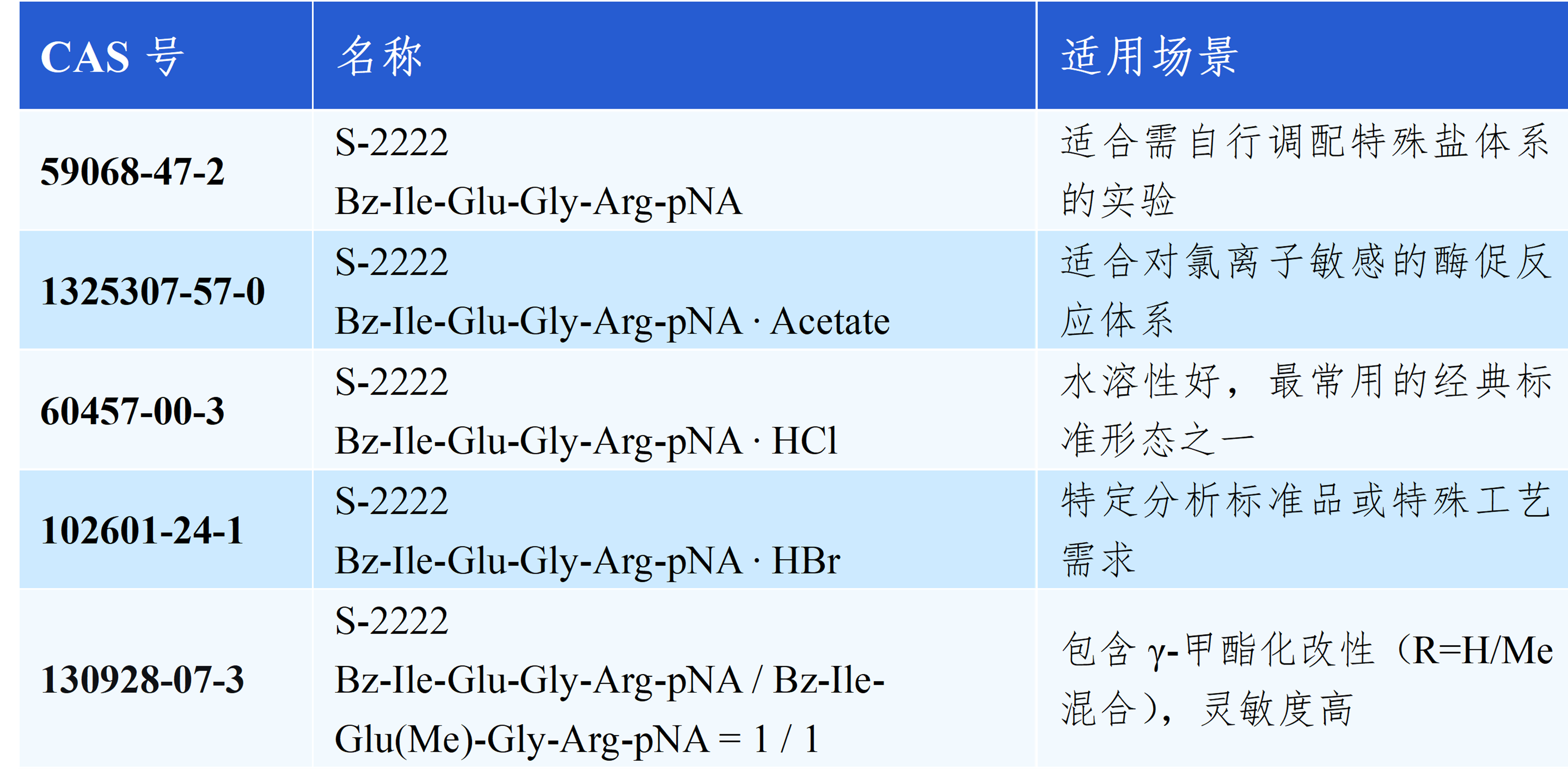
Table 1 GeneSeqTools S-2222 Series
II. Working Principle
The detection principle of the chromogenic substrate S-2222 is based on an enzymatic chromogenic reaction. S-2222 can be specifically recognized and catalytically hydrolyzed by FXa, and upon cleavage of its amide bond (Arg-pNA), it releases the chromogenic group – p-nitroaniline (pNA). This product is available in various salt forms including hydrochloride and acetate. The chromogenic reaction principle is the same for all salt forms, and the detection results are not affected by the salt form; you can choose flexibly based on your experimental system.
• Chromogenic mechanism: When FXa catalyzes the hydrolysis of S-2222, it specifically cleaves the peptide chain, releasing the chromogenic group p-nitroaniline (pNA).
• Signal readout: The released pNA exhibits significant light absorption at 405 nm, with absorbance directly proportional to enzyme activity, enabling highly sensitive quantitative detection.
III. Application Scenarios
1. Coagulation factor detection
• Determination of Factor X (FX) activity in blood
• Determination of Factor Xa (FXa) activity in blood
2. Anticoagulation therapy monitoring
• Detection of Factor Xa inhibitors in blood
• Determination of heparin sodium concentration in blood (based on anti-Xa activity)
3. Coagulation cascade-related detection
• Determination of Factor VIII activity in blood
4. Specialized applications
• Determination of coagulase in horseshoe crab blood
• Determination of trypsin activity in duodenal fluid
IV. Core Advantages
✅ Clear specificity, well-defined target
• Enzyme selectivity: S-2222 exhibits high selectivity for FXa and is insensitive to thrombin, ensuring that detection in complex coagulation systems targets the enzyme of interest rather than interfering signals.
• Cross-reactivity profile: It also responds to trypsin, subtilisin, acrosin, and Factor XIIa, extending its applicability to various enzyme activity detection scenarios.
✅ High sensitivity, measurable at low concentrations
• Strong chromogenic response: The released pNA has a high molar extinction coefficient at 405 nm, enabling precise detection of low-concentration enzyme activity.
• Classical methodology: S-2222 is one of the most widely referenced chromogenic substrates in the field of FXa activity detection, with methodological performance validated over more than four decades.
✅ Robust method, intuitive results
• Convenient detection: The released pNA is directly quantified by colorimetry at 405 nm, requiring no complex sample pretreatment or derivatization steps.
• Platform adaptability: The reaction kinetics are stable, suitable for endpoint or kinetic methods, and compatible with automated coagulation analyzers and standard microplate readers.
✅ Stable storage, long-lasting performance
• Dry powder stability: The dry powder is stable for long periods at -20°C (HPLC purity > 98%), providing a generous shelf-life window for procurement and stocking.
• Solution compatibility: Prepared working solutions can be stored stably under appropriate conditions, facilitating daily experimental scheduling.
✅ Independent supply, worry-free procurement
• Domestic production: Key synthetic routes and purification processes are fully independently controlled, unaffected by import controls or international logistics fluctuations.
• Performance comparable to imports: Validated by HPLC and methodology, performance parameters are comparable to imported brands.
• In-stock supply: Regularly stocked inventory, supporting multiple specifications from milligram-level R&D trials to gram-level bulk procurement, meeting the needs of different experimental stages.
V. Frequently Asked Questions (Q&A)
Q1: Which enzymes does S-2222 respond to?
A: S-2222 is highly sensitive to FXa and also exhibits high sensitivity to trypsin, subtilisin, acrosin, and Factor XIIa. However, it is insensitive to thrombin and most other tested enzymes (such as Factor IXa, kallikrein, etc.).
Q2: What is the difference between S-2222 and S-2238?
A: The two target completely different coagulation factors; choose the appropriate substrate based on your detection target.
• S-2222 targets FXa, with the sequence Bz-Ile-Glu-Gly-Arg-pNA, primarily used for FXa activity detection, heparin anti-Xa activity determination, Factor Xa inhibitor detection, etc. It is insensitive to thrombin.
• S-2238 targets thrombin, with the sequence H-D-Phe-Pip-Arg-pNA, primarily used for thrombin activity and antithrombin III detection, and is highly sensitive to thrombin.
Selection reference:
Choose based on your detection target – select S-2222 for FXa-related indicators, and S-2238 for thrombin-related indicators. Both are chromogenic substrate methods with consistent procedures and detection platforms (405 nm), and can be flexibly used together in the same coagulation system.
Q3: Both S-2222 and S-2765 are FXa chromogenic substrates. What are the differences and how should one choose?
A: Both are FXa chromogenic substrates, with the core difference lying in sequence design and application focus.
• S-2222 has the sequence Bz-Ile-Glu-Gly-Arg-pNA, directly mimicking the natural FXa cleavage site in prothrombin. It is highly sensitive to FXa, insensitive to thrombin, and has over forty years of literature accumulation and widespread clinical application.
• S-2765 has the sequence Z-D-Arg-Gly-Arg-pNA, an artificially designed sequence with higher affinity for FXa (lower Km) and higher sensitivity, also widely used for FXa activity detection and heparin anti-Xa activity determination.
Selection reference:
Both substrates have their strengths – S-2222's sequence directly mimics the natural FXa cleavage site with deep literature support; S-2765 offers higher affinity and sensitivity for FXa. Both are supported by pharmacopoeia methods. The final choice should consider your laboratory's existing systems, historical data habits, or consult our technical team for further recommendations.
Q4: What salt forms does S-2222 have? How should one choose when developing IVD kits?
A: S-2222 is available in free base, hydrochloride, acetate, methyl ester, and other forms. The chromogenic reaction principle is identical across all salt forms, and detection results are not affected by the salt form. The main differences lie in solubility and buffer system compatibility.
Selection reference:
• General kit development (universal recommendation): Acetate salt (CAS: 1325307-57-0) or hydrochloride salt (CAS: 60457-00-3) offers good water solubility and is suitable for most coagulometer or microplate reader kit development.
• High sensitivity needs: The mixed methyl ester hydrochloride with modified structure exhibits extremely high catalytic response in specific hydrolysis reactions, suitable for low-concentration target analysis.
• Special buffer systems: If the kit is sensitive to chloride ions, the acetate salt form is recommended.
If unsure, please contact our technical team for recommendations based on your specific formulation.
Q5: Is S-2222 suitable for automated detection?
A: Yes. S-2222 has stable reaction kinetics and has been widely used in supporting tests for automated coagulation analyzers. The kinetic method is the preferred approach, and it is also compatible with endpoint methods, adaptable to automated coagulation analyzers and standard microplate readers. We recommend that customers validate based on their own instrument platforms to determine optimal adaptation conditions.
Q6: How should S-2222 be stored? How long can it be kept after reconstitution?
A: It is recommended to store dry at -20°C. This product is somewhat hygroscopic, so moisture protection is important. For reconstitution, deionized water or specified buffer is recommended. Prepared working solutions should be aliquoted and stored, avoiding repeated freeze-thaw cycles and microbial contamination.
Q7: What are the quality standards for S-2222?
A: The product meets the quality standard of HPLC purity > 98%, with key indicators (purity, moisture, content, etc.) tested batch by batch to ensure batch-to-batch consistency. Storage conditions clearly require -20°C cold chain preservation, meeting the standard quality control requirements for FXa-specific substrate raw materials, providing a foundational guarantee for downstream product stability.

Extended Services
Classic chromogenic substrate S-2222, domestically supplied – performance comparable, delivery worry-free.
For more "coagulation test chromogenic substrates" or custom packaging services, please call +86-13302967066!
GeneSeqTools Bioscience & Technology is dedicated to providing reliable domestic alternative solutions for gene sequencing, molecular diagnostics, and microbial detection.
For related products such as blood cell dyes and buffer salts, you can view the complete product line and technical specifications on [MedSun Biotechnology Website].

Founded in 2015, it is a high-tech enterprise focusing on microbial testing、 gene sequencing and in vitro molecular diagnostics in the R&D, production, and sales of biochemical reagent raw materials. Committed to providing high-quality biochemical reagent raw materials and professional custom synthesis services, the product portfolio covers more than a dozen categories and nearly a thousand innovative products. Upholding the core philosophy of “customer first, integrity and professionalism”, we serve with dedication to meet customers’ diverse needs in research and testing.

Official WeChat account: Shenzhen GeneSeqTools Bioscience & Technology Co. Ltd.
GeneSeqTools official website: http://www.geneseqtools.com
Hotline: +86 0755-23251735
QQ: 2370561481
Email: sales@geneseqtools.com
Related Links
- · FAQs about Geneseqtools BioTech [2024-07-04]
- · In Stock | Mechanism of 3′-O-N3-dUTP: Why Reversible Terminator Nucleotides are the Core Substrates for SBS Sequencing? [2026-08-21]
- · In Stock | Principles and Applications of X-GlcNAc Chromogenic Substrate: A Classic NAGase Chromogenic Substrate [2026-08-27]
- · From "Protein Expression" to "Actual Enzymatic Activity" — Detection Solution Using Z-Phe-Arg-4MβNA Fluorescent Substrate [2026-08-28]
- · In Stock | Yeast Two-Hybrid Screening Made Easy — X-α-Gal Turns Positive Clones Blue [2026-09-09]
- · In Stock | Magenta-Gal: A Magenta β-D-Galactosidase Chromogenic Substrate for Instant Identification of Positive Clones [2026-09-11]
- · Hot Product | Principles and Applications of S-2366 (Pyr-Pro-Arg-pNA) for Coagulation Factor FXIa Activity Detection [2026-09-15]
- · In Stock | Rapid Visual Detection of Cronobacter in Infant Formula Milk Powder: Domestic X-α-Glc Solution [2026-09-18]